
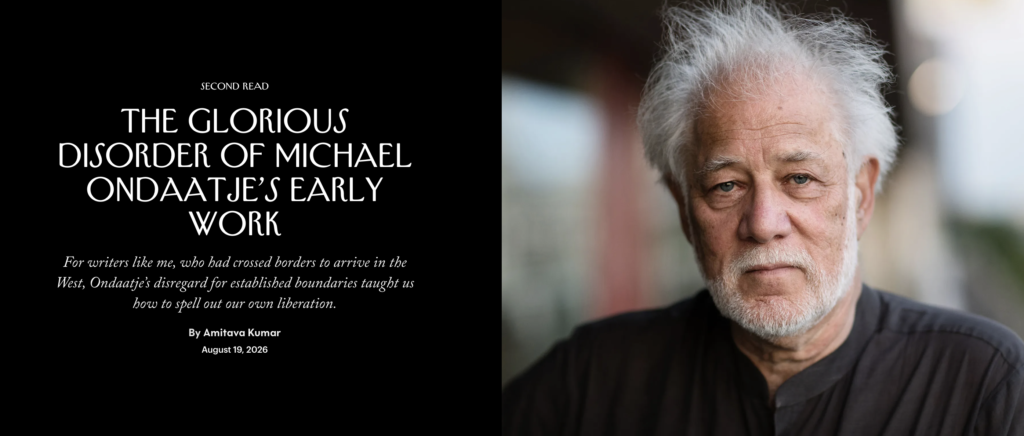
I have written an essay for the New Yorker “Second Reading” series expressing admiration for the early works of Michael Ondaatje.
I have written an essay for the New Yorker “Second Reading” series expressing admiration for the early works of Michael Ondaatje.
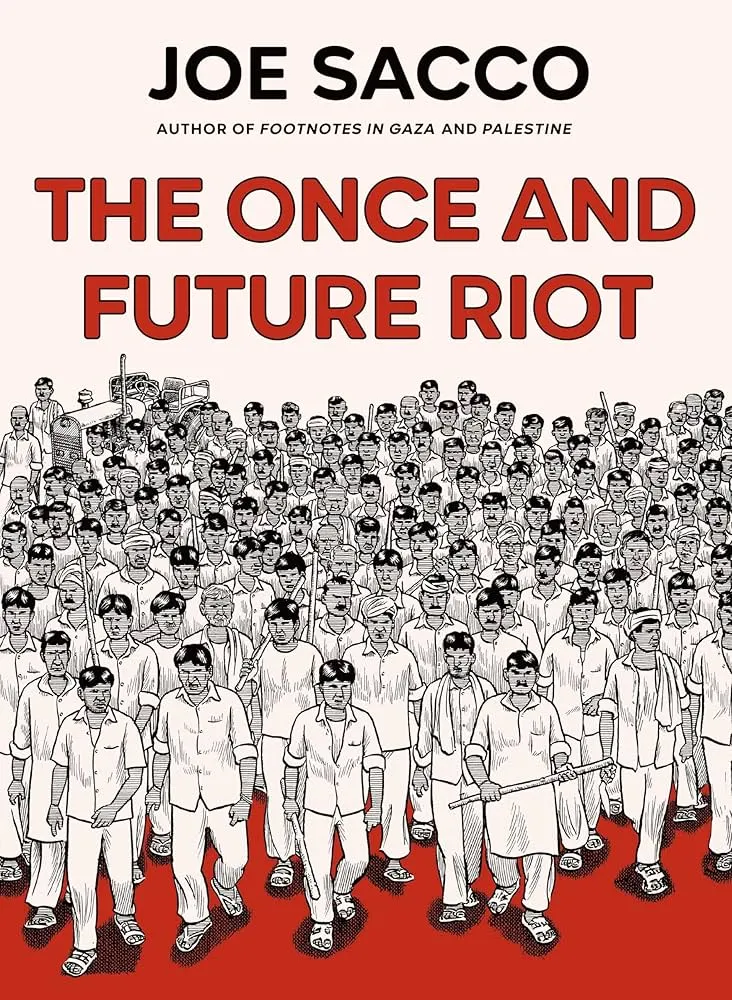
Joe Sacco’s excellent report from India, The Once and Future Riot, was published by Metropolitan Books in the US last year, but its publication in India has run into trouble. The book was to be distributed by Penguin India and in recent weeks, we have learned that the publishers have decided to withdraw it. Penguin India reportedly sent Sacco a several-page response seeking changes; Sacco has said that these changes included a demand for the removal of a line about the rise of “Hindu hegemony” in the country. (What is Penguin India thinking, if it is thinking at all? To remove a line about the growth and consolidation of “Hindu hegemony” in contemporary India is akin to removing the Himalayas from the subcontinent. After that, there is no there there.)
My report on the book and my conversation with Sacco has been published by Scroll. Click here.

Join me in reading V.S. Naipaul’s The Enigma of Arrival. This is under the auspices of A Public Space. We start on March 23, 2026. The reading will stretch over 30 days; reading a daily average of 10-12 pages. My daily notes on the pages we are reading will be emailed to you if you sign-up with APS. After the final day of reading we will have a webinar discussion about the novel on April 21 and you can register for that here.
Here is more from the website of A Public Space:
The Enigma of Arrival by V.S. Naipaul was published in March 1987. In its citation for the Nobel Prize for Literature, which he was awarded in 2001, the Swedish Academy called the book a “masterpiece” in which “Naipaul visits the reality of England like an anthropologist studying some hitherto unexplored native tribe deep in the jungle.” That was interesting, this reversal of the gaze by a postcolonial writer, but The Enigma of Arrival has fascinated me more for what the Academy had to say about Naipaul’s “inimitable voice,” disregarding genres and fashioning “a style of his own, in which the customary distinctions between fiction and non-fiction are of subordinate importance.” How to understand the book’s originality? More than one writer has talked about their response to a book that is boring and yet mesmerizing: How is the writer able to do this? I want to know. Maybe we can discuss the book’s beguiling rhythm: Is it that of nature itself, and the pace attuned to the time it takes for the narrator to heal. And all the detailed descriptions of the new landscape—is it because, as Salman Rushdie put it, “the immigrant must invent the earth beneath his feet”?
 I have a new piece in the current issue of Outlook. It is an essay on the landscape of memory along with six of my drawings. You can read the whole piece here.

My report on the Andamans is out in Granta. It is probably the fourth essay on India, part-memoir, part-travel, that Luke Neima has helped me publish there, and my appreciation for Luke as an editor, thoughtful and exact, is profound and filled with gratitude. (He would have improved this preceding sentence. I’m writing in a cab taking me to my hotel in Delhi after a long day of travel.) Here is how the essay begins:
The guide at the Cellular Jail Museum in Port Blair first took us into the small room that had served as the gallows when the place was a working prison under British rule. The jail had been a part of the colonial penal settlement in the Andaman Islands. Situated more than a thousand kilometers from the Indian mainland, the Andamans are a remote archipelago made up of nearly two hundred islands, of which only a few are inhabited. There is evidence to suggest that the indigenous Andamanese tribes have lived on some of the islands since perhaps the end of the Last Glacial period. For much of my life, long before the Andamans became popular as a vacation site, they loomed large as a notorious penal settlement. Thousands of Indians, many of them nationalist rebels, died there. And this fact was confirmed during my visit to the prison-museum in Port Blair. Three nooses hung from the roof of the small room; the rope was new and so was the green paint on the wooden walls, but everything else had been preserved from the time when executions were still taking place. There was a door on the side and a short flight of steps leading to an underground chamber. A sunken rectangular area in the floor marked the space directly under the spot where a body would have dropped with the rope around the neck.
More here.


Aleph Book Company in India have published several of my books and in December this year they will be bringing out a new one. A short book in their excellent Essential India series. My thanks to Aleph—in particular, David Davidar. I’ll be participating on November 30 at a book event at Champaca Bookstore the Catholic Club in Bengaluru and at Kunzum in Delhi GK II on December 2. Details here. More here on my Substack.

Screenshot
Brick literary magazine has released the podcast conversation between Teju and me. This is a part of their Writer to Writer series.

I’m very lucky to have been awarded a Hawthornden Residency at Casa Ecco on Lake Como. As I report in my post, I arrived here and worked on the manuscript of the short book that will be published by Aleph under the title The Social Life of Indian Trains: A Journey. This is going to be a part of Aleph’s Essential India series.
Half of the residency is over—will I make good use of the half that remains? What is the important lesson from Akira Kurosawa that I must remember as I work on my book? Read my report here.

My current trip to India is coming to an end. Have spent a lot of time in Bengal and it has been good. Tonight I’ll conduct a writing workshop at The Bookshop in Jor Bagh, and then get on a plane. In this post I want to share something different. In mid-July, while I was leading a workshop at the Cullman Center for school teachers and doing research, I was interviewed by Julie Carlsen, a curator at the New York Public Library, for the library’s “Researcher Spotlight” series.Read the interview here.